
Why Is My RCD Tripping?
A practical New Zealand homeowner guide to understanding RCD trips, narrowing the problem down safely, and finding common faulty appliances before calling an electrician.
Why is My RCD Tripping -Quick Answer
If your RCD keeps tripping, it is usually detecting current leakage from an appliance, outdoor light, pump, garden lighting transformer, fridge, dishwasher, washing machine or other item connected to the protected circuit.
The safest first step is to confirm you are dealing with an RCD, not a normal circuit breaker. Then you can turn off the breakers protected by that RCD, reset it, and turn the breakers back on one at a time to narrow the fault down to one circuit.
What you’ll learn
- How to identify an RCD
- How an RCD protects you
- RCD versus circuit breaker trips
- How to narrow down the faulty circuit
- Why physical unplugging matters
- Common appliances that cause trips
- Outdoor lighting and moisture problems
- When to stop and call an electrician
Important safety note
This guide is for basic homeowner troubleshooting only. It does not involve removing switchboard covers, opening fittings, dismantling appliances or touching wiring. If something trips with a bang, pop, burning smell, heat, visible damage, or will not reset after safe checks, stop and call a licensed electrician.
Quick Checks First
| Is it an RCD? | An RCD is often double the width of a normal breaker and usually has a small test button marked “T” or “Test”. |
| Is it an MCB? | A normal circuit breaker usually protects against overload or short circuit. If it trips hard straight away, do not keep resetting it. |
| Turn off protected breakers | Turn off the individual breakers to the right of the RCD, then reset the RCD. |
| Turn breakers on one at a time | The breaker that makes the RCD trip again is likely the circuit with the fault. |
| Leave the problem circuit off | Turn the other breakers back on, then go hunting around the house for what is not working. |
| Physically unplug appliances | Do not only switch suspect appliances off. Unplug them where possible, then test again. |
First: Is It an RCD Tripping or a Circuit Breaker Tripping?
Before following this guide, it is important to identify whether you are dealing with an RCD tripping or a normal circuit breaker tripping. They can look similar in a switchboard, but they are protecting against different types of faults.
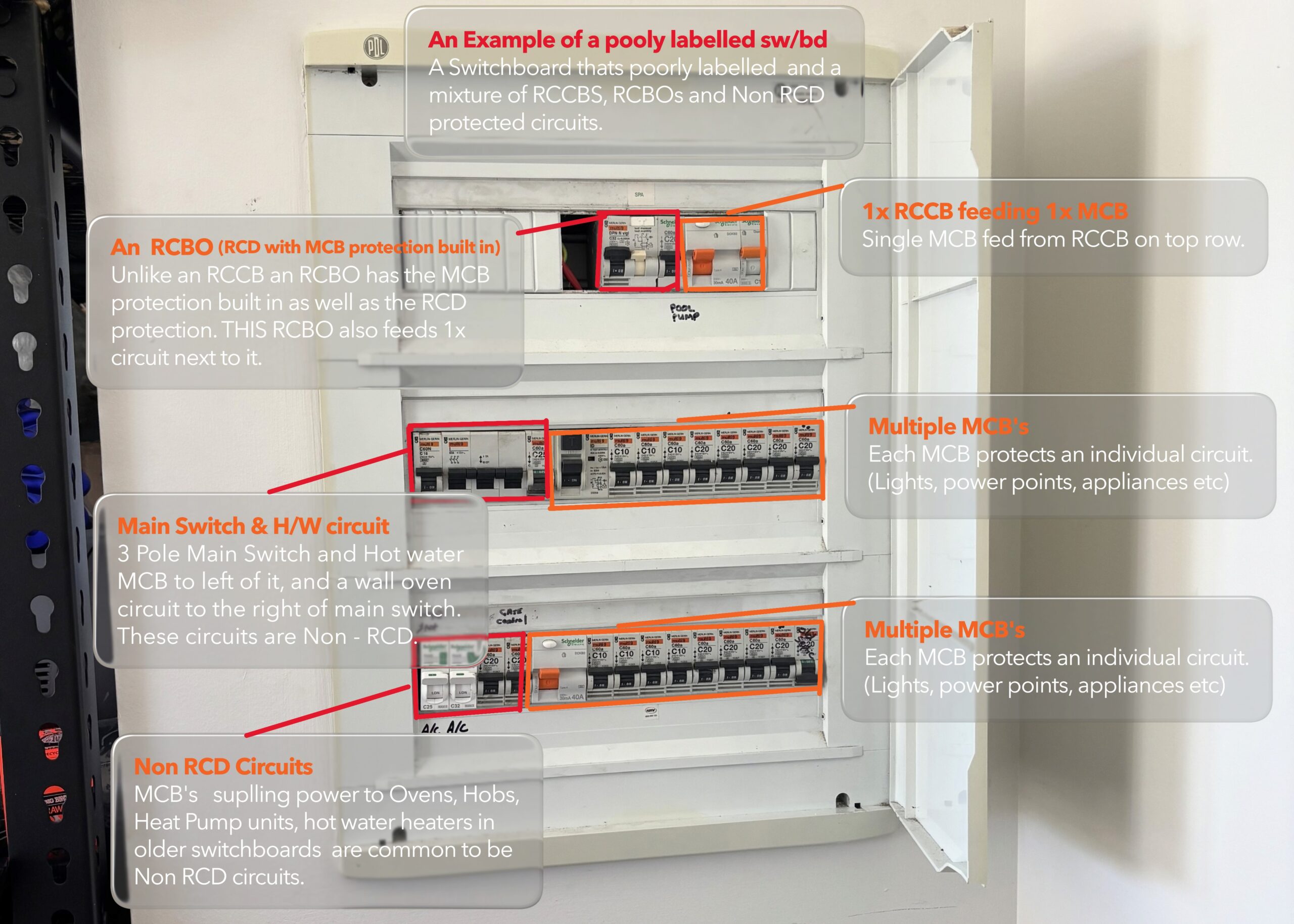
An RCD, sometimes called an RCCB, is usually wider than a normal breaker and normally has a test button on the front. The button may be marked “T” or “Test”. A normal MCB circuit breaker is usually a single-width switch and is designed to trip on overload or short circuit conditions.
This guide is aimed at RCD faults only. If a normal circuit breaker trips, resetting it once may be okay. But if it trips straight away again, especially with a pop, harsh flick, burning smell, heat or visible damage, stop resetting it and contact a licensed electrician.

What Does an RCD Actually Do?
An RCD is a very sensitive safety device designed to help protect people from electric shock. A normal circuit breaker mainly protects the cable from too much current. An RCD is different because it looks for electricity leaking where it should not be going.
In simple terms, the RCD measures the current going out on the phase conductor and compares it with the current coming back on the neutral conductor. Under normal conditions, those two should match.
If there is a difference, it may mean some current is leaking to earth, through a faulty appliance, through moisture, or in the worst case through a person. A typical domestic RCD is designed to trip when it detects around 30 milliamps of leakage current, often within a fraction of a second.
That sensitivity is what makes RCDs such excellent safety devices. It is also why they can trip when an appliance has a small fault that may not have shown up in an older house without RCD protection.
Why Some RCDs Protect Several Breakers
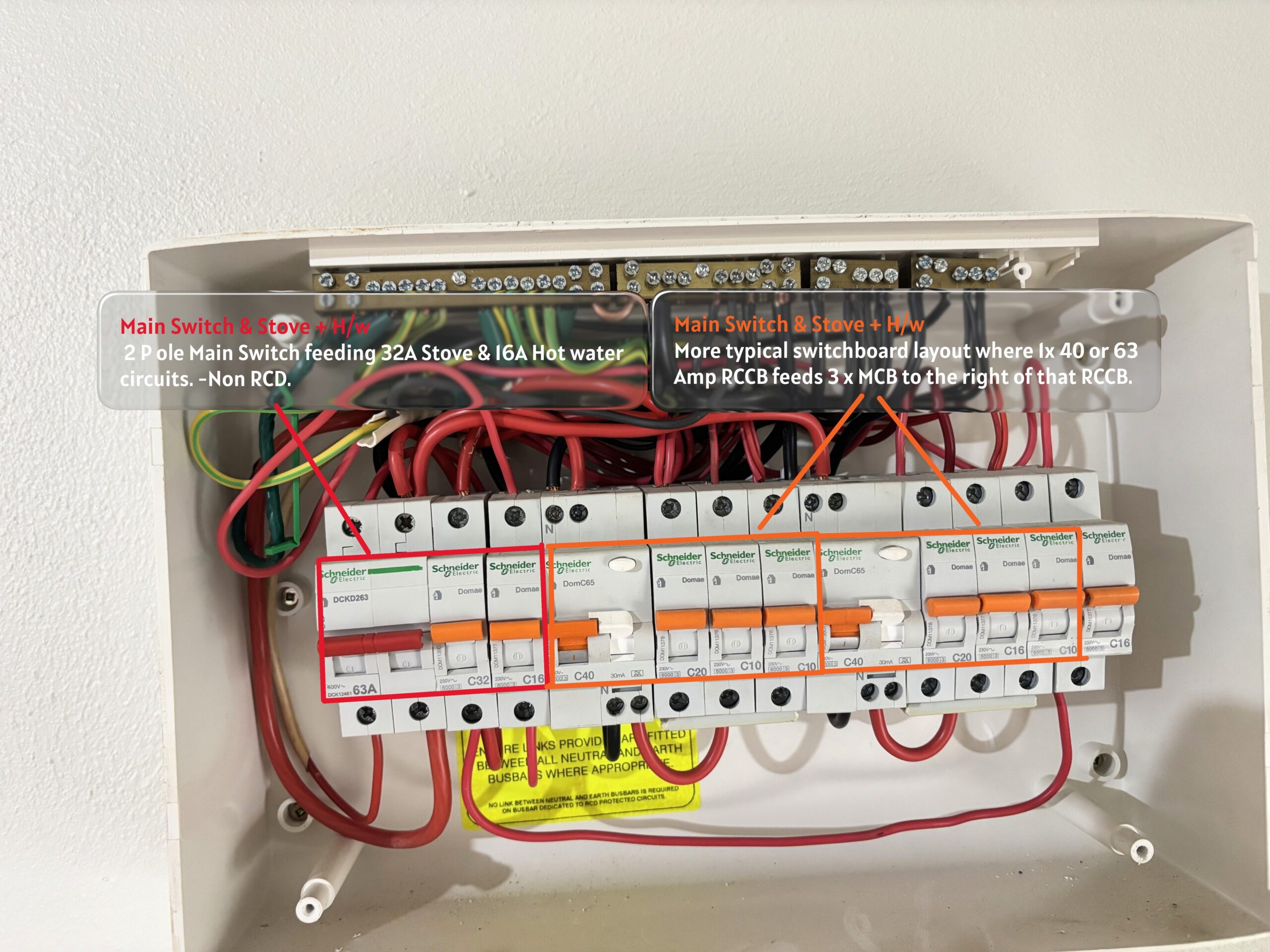
In many switchboards, the RCD is installed to the left of the circuit breakers it protects. The individual breakers to the right are often the sub-circuits fed by that RCD. This is why the fault-finding process normally starts by turning off the breakers to the right of the tripping RCD.
Older switchboards from the 1990s and early 2000s commonly had one RCD at the start of a row feeding many breakers. In some homes, one RCCB may protect a whole row of power and lighting circuits.
More modern boards may split the house over more RCDs, with each RCD protecting fewer circuits. For example, one RCD may feed three MCBs, another RCD may feed another three MCBs, and so on. The troubleshooting idea is the same: identify which breakers are protected by the RCD that is tripping, then test those one at a time.
How to Narrow an RCD Fault Down to One Circuit
If the RCD trips and will not stay on, the first goal is to work out which circuit is causing the issue. This is where many homeowners can save themselves time, because you may be able to narrow the fault down before calling an electrician.
Once you have done this, most of the house may be working again. Now you can go hunting for what is not working. If the label says “PP”, it may be a power point circuit. If it says “LT”, it may be a lighting circuit. Labels are not always perfect, but they can give you a starting point.
What If the RCD Still Will Not Reset With All Breakers Off?
It is not the most common cause, but an RCD itself can be faulty. If all of the protected circuit breakers after the RCD are turned off and the RCD still will not reset, that may indicate a faulty RCD unit or a fault inside the switchboard.
At this point, stop troubleshooting. Do not remove the switchboard cover or try to access the wiring. This is a job for a licensed electrician with the correct test equipment.
If the Problem Circuit Is Power Points
If the circuit that trips the RCD is labelled as power points, start looking around the house for power points that are not working. Once you have found the area affected, the next step is to physically unplug appliances from that circuit.
This part matters: do not only switch appliances off at the wall if you can unplug them. Physically unplug suspect items where possible, then go back to the switchboard and try resetting the RCD and circuit breaker again.
If the RCD now stays on, plug the appliances back in one at a time and turn them on. When the RCD trips again, you can be fairly confident the last appliance you plugged in is the likely culprit.
If the Problem Circuit Is Lights
If the tripping circuit is a lighting circuit, a good place to start is outside. Outdoor lights are exposed to rain, damp air, insects, weather damage and sometimes direct water blasting during house washing.
A very common scenario is an RCD trip after the house has been washed. Water can be forced into sensor lights, wall lights and outdoor fittings. Try turning off all outside lights first, then reset the RCD and see whether the fault clears.
Sometimes turning the light switch off is not enough. Moisture inside a fitting can still cause a neutral-to-earth leakage fault, and that can trip the RCD even when the light switch is off. If turning the outdoor lights off does not clear the fault, it may need an electrician to disconnect, dry, repair or replace the affected fitting safely.
Common Appliances and Items That Trip RCDs
Over the years, some appliances and outdoor items come up again and again when fault-finding RCD trips. If you have narrowed the fault down to a power circuit, these are often good places to start.
When Should You Call an Electrician?
Safe homeowner fault-finding can help narrow down the issue, but it has limits. If the RCD keeps tripping after you have unplugged appliances, if the fault appears to be in lighting or fixed wiring, or if you cannot clearly identify the affected circuit, it is time to call an electrician.
- The RCD will not reset with all protected breakers off.
- A normal circuit breaker trips immediately with a pop or harsh flick.
- There is a burning smell, heat, buzzing, cracking, smoke or visible damage.
- The issue appears to involve outdoor lights, fixed wiring, pumps or switchboard components.
- You have narrowed it down but cannot safely unplug or isolate the item.
Frequently Asked Questions
Is an RCD the same as a circuit breaker?
No. A normal circuit breaker usually protects against overload and short circuit faults. An RCD looks for current leakage to earth and is designed to help protect people from electric shock.
Why does my RCD trip when I plug in an appliance?
The appliance may have leakage current caused by moisture, a damaged heating element, motor fault, compressor fault or insulation breakdown. If the RCD trips when that appliance is plugged in, stop using it until it has been checked or replaced.
Can outdoor lights trip an RCD?
Yes. Outdoor lights are a very common cause, especially after heavy rain or house washing. Water can enter sensor lights, wall lights, garden lights or transformers and create leakage current.
Can a fridge trip an RCD?
Yes. Fridges can trip RCDs due to compressor faults, defrost element faults or age-related insulation breakdown. This can become obvious when an older fridge is moved into a house with modern RCD protection.
Can the RCD itself be faulty?
Yes, but it is less common. If all protected circuit breakers are off and the RCD still will not reset, the RCD or switchboard needs to be checked by a licensed electrician.
So, Why Is Your RCD Tripping?
In many cases, an RCD trips because it has detected leakage current from an appliance, outdoor fitting, pump, garden lighting transformer or another item on the protected circuit. The RCD is sensitive because it is designed to protect people from electric shock.
The safest troubleshooting process is to confirm it is an RCD, turn off the breakers protected by it, reset the RCD, then turn those breakers back on one at a time. Once you find the circuit that trips it, leave that circuit off, restore the rest of the house where possible, and investigate what is not working.
For power circuits, physically unplug suspect appliances and plug them back in one at a time. For lighting circuits, start with outside lights and fittings exposed to weather or water blasting. If the issue cannot be safely narrowed down, call a licensed electrician.
Related Guides
To keep this guide focused, these related questions are best covered in their own articles.
- Why Are My Lights Flickering?
- How Much Does a Heat Pump Cost to Install?
- Why Is My Heat Pump Dripping Water?
- How Often Should I Service My Heat Pump?
- How Can I Reduce My Power Bill?
- Should I Upgrade My Old Switchboard?
Need help with an RCD that keeps tripping?
If you have narrowed the fault down but cannot safely find the cause, we can test the circuit, identify the faulty appliance or wiring issue, and repair it properly.