Why Is My Power Bill So High?
A practical New Zealand homeowner guide to high electricity bills, peak power pricing, hot water faults, EV and spa running costs, and simple ways to reduce your energy use.
Quick Answer
A high power bill is usually caused by one of four things: higher usage, higher rates, loads running at expensive times, or a fault that is wasting energy without you noticing.
The biggest areas to check first are hot water, heating, EV charging, spa pools, pool pumps, dryers, old fridges and whether your plan actually suits how your household uses power.
If your plan has peak, off-peak and night rates, shifting large controllable loads away from morning and evening peak times can make a real difference.
What you will learn
- How to read your power bill
- Why peak times matter
- How time-of-use rates work
- How to spot hot water faults
- Why spas and EVs can cost more than expected
- How smart relays can shift loads
- When free power plans help or hurt
- Practical energy saving tips
Why this matters
A power bill is not just one number. It is made up of daily charges, kWh rates, metering, network charges, GST, discounts, time bands and sometimes controlled load or low user plan settings.
Reducing the bill is often about finding the big loads, fixing faults, and moving flexible loads to cheaper times.
The Most Common Reasons Power Bills Jump
| Hot water | Electric hot water can be one of the largest household loads. Leaks, faulty valves, thermostats or long shower routines can quietly add a lot of cost. |
| Heating and cooling | Heat pumps, ducted systems, plug-in heaters and underfloor heating can use a lot of energy if they run for long periods or at high settings. |
| Peak power use | Morning and evening use can be more expensive on time-of-use plans. Showers, cooking, heating, EV charging and dryers often overlap at these times. |
| Spas, pools and EVs | These are controllable loads. If they run during peak times, they can cost much more than they need to. |
| Old lighting | Switching old incandescent or halogen lamps to LED is one of the easiest wins, especially in homes with lots of downlights. |
| Wrong plan | A low user, standard, free power or time-of-use plan can be great for one household and expensive for another. |
Start by Reading Your Power Bill Properly
Before changing appliances or blaming one device, look at how the bill is built. Most power bills include a fixed daily charge, one or more kWh usage rates, GST, metering details and sometimes separate peak, off-peak, night or controlled-load rates.
Your kWh usage tells you how much energy you used. Your rate tells you what you paid for each kWh. A household can use the same amount of power as last year and still pay more if the plan, rates or usage times have changed.
Check whether your bill is based on actual smart meter readings or estimates. If a previous bill was estimated low and this bill is corrected, it can look like a sudden jump even though the usage happened over a longer period.
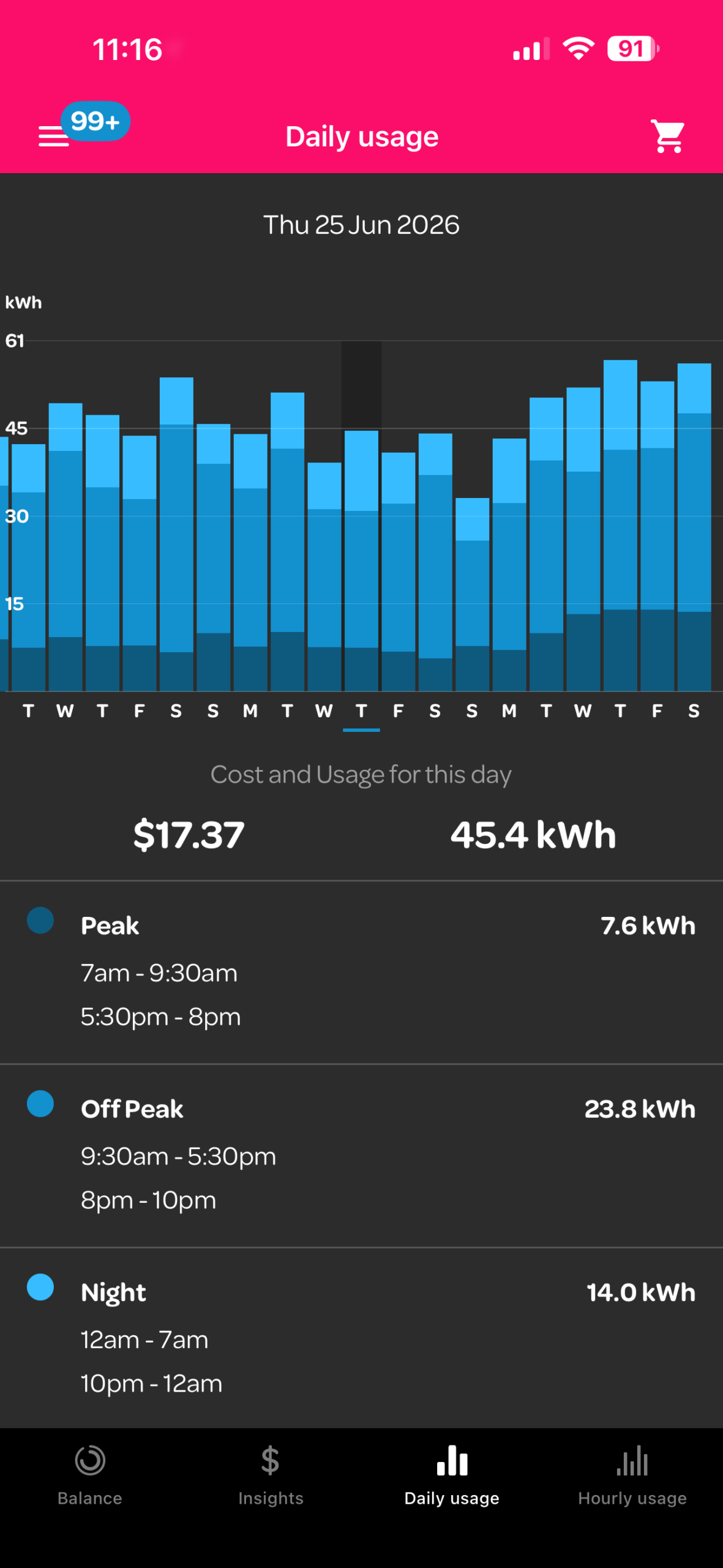
Most energy providers now have smartphone apps or online portals that show daily or half-hourly usage history. These are useful because they help you see when your power is being used, what could be pushed out of peak times, and whether anything looks unusual.
For example, if the app shows a large power draw in the middle of the night when you believe nothing is running, that could point toward hot water reheating, a spa, a pool pump, an EV charger, underfloor heating or a fault that needs checking.
Low User, Standard User, Free Power and Time-of-Use Plans
Choosing a power plan is not just about the lowest advertised rate. You need to compare the daily charge, the kWh rate, when the cheaper rates apply, and whether your household can actually shift usage into those cheaper windows.
If you are on a low user plan but your household uses a lot of electricity, the higher kWh rate can outweigh the lower daily charge. Larger families, electric hot water, EV charging, spa pools, pool pumps and electric heating can push usage high enough that a standard plan may be better.
Free power weekends or free power hours can be good if you deliberately use them for laundry, dishwashing, EV charging, spa heating or hot water. But if you do not use those free windows, the normal paid rates outside them may be higher than a simpler plan.
Time-of-use plans can also be excellent, but only if you shift load. If you keep running hot water, EV charging, dryers, cooking and heating during peak windows, you may not get the savings you expected.
Why Morning and Evening Peak Times Matter
Many time-of-use plans charge more during peak periods, commonly around the morning and evening when households are using power at the same time. Exact times depend on your retailer and network area, so always check your own bill or plan details.
The costly part is load stacking. A family gets home, the heat pump goes on, dinner starts, the oven and hob run, the dryer is used, kids shower after sport, the hot water cylinder starts reheating, and the EV gets plugged in. On a peak-rate plan, that can all happen at the most expensive time of day.
Some loads need to happen when you need them. Cooking dinner is hard to move. But other loads are flexible: EV charging, spa heating, pool pumps, dishwashers, washing machines, dryers and hot water reheating can often be delayed.
Dishwashers are a simple example. Most modern dishwashers have a delay-start feature, so you can load it after dinner and set it to start after 9pm, or delay a morning load until after the morning peak window has finished.
Peak vs Off Peak vs Night Rate Calculator
Use this simple example calculator to compare the cost of running a flexible load at different rates. Try it with an EV charger, spa pool, pool pump, dryer or hot water cylinder. Replace the example rates with the actual rates from your bill or power company app.
The example rates below are only a guide and are intended to be in the general range of time-of-use residential plans seen around the Waikato. Your actual Te Awamutu rates can vary by retailer, meter setup, plan, network pricing, low-user status and GST treatment.
Moving this load from peak to night could save about $74.74 per month in this example.
For example, using Powershop-style rates of 56.12c peak, 38.23c off peak and 24.98c night, a spa or EV charger using 8kWh a day would cost much less if it ran at night instead of during peak. The exact result depends on your real rates and how much energy the appliance uses.
Not every load can be shifted. Cooking, lighting and normal family routines often happen when they happen. But even shifting hot water, dishwashing, spa heating and EV charging can have a big effect on the power account.
Hot Water Is Often the First Place to Look
Electric hot water can make up a large share of a household power bill, so a small fault or poor control strategy can become expensive quickly.
One common example is evening showers. Three kids come home from sports training around 5pm, everyone showers, and the hot water cylinder starts reheating during the peak power window. If the cylinder is large enough and has enough stored hot water, a smart relay or approved timer may be able to lock out the element until after the expensive period.
A device such as a Shelly-style smart relay can be used as part of a properly designed control setup to move hot water heating outside peak times. This must be installed correctly by a licensed electrician, with the right contactor, isolator, enclosure, current rating and fail-safe design for the cylinder.
Do not simply turn hot water down too far. Hot water must be stored hot enough to manage legionella risk, and the outlet temperature must be safe at taps and showers.
| What to check | Why it can increase the bill | Who should check it |
|---|---|---|
| Overflow on roof or drain | If hot water is continuously coming out of the overflow, the cylinder may keep reheating replacement cold water. | Plumber |
| Ajax / pressure valve fault | A faulty valve can waste hot water and keep the cylinder working. | Plumber |
| Thermostat fault | A thermostat fault can cause overheating, poor control or constant reheating. | Electrician |
| Poor insulation | Older cylinders and unlagged pipes lose heat faster, so the element runs more often. | Electrician / plumber |
| Wrong timing | The cylinder may reheat during expensive peak periods instead of cheaper off-peak times. If you have a large enough cylinder, a smart device may be able to lock out heating during the most expensive periods. | Electrician |
Spas, EV Chargers, Pool Pumps and Other Loads You Can Shift
Some appliances do not need to run the moment you turn them on. These are the loads that can save money on a time-of-use plan.
An EV charger is a good example. Most vehicles sit parked overnight for many hours, so charging can often be delayed until the night rate. Smart EV chargers can automate this and some can reduce charging when the house is using too much power.
Spas and pools are similar. A spa with a poor cover can lose heat constantly, then use more power to recover. A pool pump running at peak times may cost more than it needs to. Timers, covers and sensible temperature settings can all help.
Heating Your Home Without Blowing the Bill
Heating is one of the biggest seasonal bill drivers. Heat pumps are usually efficient, but they still use more energy when the house is cold, draughty, poorly insulated or the temperature is set too high.
Try to heat the rooms you use, close doors to unused rooms, clean heat pump filters, use timers sensibly and avoid running heaters all day if the room is not being used.
Dirty heat pump filters restrict airflow and make the unit work harder. Clean the filters regularly, and if the heat pump is noisy, smelly, icing up, not heating well or has not been serviced for a long time, arrange a professional service.
Insulation, draught stopping, ventilation and moisture control all affect the bill too. A dry, insulated home is easier to heat in winter and easier to keep cool in summer. If the home is shut up all day while everyone is at work, a ventilation system may help manage stale, damp air. Good bathroom extract fans also help remove moisture before it spreads through the house.
Get rid of obvious draughts where you can. Door rolls, draught stoppers, weather seals and closing off big gaps under doors can help keep warm air in the rooms you are actually heating.
If the home is very damp and windows are running with condensation every morning, a dehumidifier can help as a short-term tool. It will use power, but removing moisture can make the home feel warmer and easier to heat. A proper ventilation system and fixing moisture sources is usually the better long-term solution.
Try to avoid relying on fan heaters for long periods. They are simple and cheap to buy, but they are a high electrical load and can become expensive quickly if used as the main source of heating.
On time-of-use plans, pre-heating before peak times can sometimes help, especially if the house is reasonably insulated. The aim is not to freeze through peak periods; it is to avoid having every large load start at once.
Are Free Power Weekends and Free Power Hours Worth It?
They can be, but only when your household uses them deliberately. A free hour is useful if you schedule dishwashers, dryers, EV charging, spa heating or other flexible loads into that window.
The catch is that the paid rates outside the free period may be higher than a normal plan. If your household does most usage outside the free window, the promotion may not save money.
Before choosing a free-power plan, compare the full bill: daily charge, peak rate, off-peak rate, controlled load, GST and how much energy you can realistically shift into the free period.
Electrical and Appliance Faults That Can Waste Power
Some high bills are not about behaviour at all. They are caused by a fault or failing appliance quietly using energy.
- Hot water overflow running on the roof or through a drain.
- Faulty thermostat, element control, contactor or timer on a hot water cylinder.
- Faulty Ajax valve, pressure reducing valve or relief valve.
- Spa heater running constantly because the cover is waterlogged, damaged or poorly sealed.
- Pool pump running too long or at the wrong time.
- Old second fridge or freezer in a hot garage.
- Heated towel rails left on 24/7 without timers.
- Underfloor heating or bathroom heating left permanently on.
- Heat pump filters blocked or outdoor unit airflow restricted.
- Faulty appliance, damaged lead or equipment running when it should be off.
Big List of Energy Saving Tips
Frequently Asked Questions
What uses the most power in a house?
It depends on the home, but hot water, space heating, EV charging, spa pools, pool pumps, clothes dryers and old refrigeration are common large loads.
Can a hot water cylinder cause a high bill?
Yes. A leaking overflow, faulty valve, faulty thermostat, poor insulation or bad timing can make an electric cylinder run far more than expected.
Is a low user plan always cheaper?
No. It depends on daily charge, kWh rate and total yearly usage. If your household uses a lot of electricity, a standard plan may be cheaper overall.
Are night rates worth it?
They can be very worthwhile if you can move large loads such as EV charging, spa heating, hot water, dishwashing and laundry into the cheaper period.
Can I put my hot water cylinder on a smart relay?
Often yes, but it must be designed and installed safely. The relay may need to control a correctly rated contactor rather than switching the cylinder element directly.
Should I turn my hot water off during peak times?
Only if the cylinder size, household use and safety settings allow it. Hot water must still be stored safely and available when needed.
Related Guides
These related guides may also help if you are planning electrical upgrades or trying to reduce household power use.
Power bill suddenly high or planning smart load control?
We can check hot water controls, switchboard timers, EV charging, spa and pool circuits, and design safe ways to shift large loads outside peak times.