
Can I Use a Heat Transfer System with a Heat Pump?
A practical New Zealand homeowner guide explaining why heat transfer systems work well with wood fires, but are usually disappointing when connected to rooms heated by a standard high wall heat pump.
Quick Answer
In most homes, I do not recommend installing a heat transfer system to move heat from a room heated by a standard high wall heat pump. It can move some air, but there usually is not enough spare heat sitting at ceiling level to make it worthwhile.
Heat transfer systems are far better suited to wood fires, where intense excess heat collects near the ceiling and can be moved to nearby rooms through short duct runs.
What you’ll learn
- What a heat transfer system does
- Why fires and heat pumps behave differently
- Why heat transfer from a heat pump is usually poor
- What duct length does to performance
- How much warmth to realistically expect
- Better options for heating more rooms
Chris’s short version
If you have a wood fire overheating the lounge, a heat transfer system can make sense. If you have a heat pump simply maintaining the lounge temperature, a heat transfer kit is usually not where I would spend the money.
Heat Transfer with a Heat Pump: Summary
| Best suited to | Wood fires, log burners and other strong central heat sources that create excess heat near the ceiling. |
| With a heat pump? | Usually not recommended. A heat pump is designed to condition the room it is installed in, not create a large bank of spare heat at the ceiling. |
| Realistic result | At best, expect a small lift in nearby rooms — often just a couple of degrees — not full room heating. |
| Duct length | Shorter is better. Long duct runs, bends and uninsulated roof spaces reduce airflow and temperature by the time the air arrives. |
| Better investment | For bedrooms or hallways, money is often better put toward another small heat pump, panel heater, or a proper ducted heat pump system. |
What Is a Heat Transfer System?
A heat transfer system is normally a fan and ducting setup that takes warm air from one room and moves it to another part of the house. A grille is usually placed high in the warm room, often near the ceiling, and the fan pushes that warm air through ducting to a hallway or bedroom.
The idea is simple: if one room has more heat than it needs, move some of that excess heat to a cooler room.
That is why heat transfer systems can work well in the right home. But the key word is excess. The system works best when there is plenty of spare heat available to move.
Why Heat Transfer Systems Work Well with Wood Fires
A wood fire can produce a huge amount of heat. In many living rooms, the heat output from a fire can be far more than the room actually needs. The room gets hot, the ceiling area becomes very warm, and homeowners often end up opening doors or windows just to let some heat escape.
This is the ideal situation for a heat transfer system. There is intense excess heat sitting around the ceiling, and a well-positioned ceiling grille can capture some of that heat and move it to nearby rooms.
For relatively short duct runs to close bedrooms, a hallway or a nearby cooler area, a heat transfer system matched with a fire can provide a genuine comfort improvement.
Why a Heat Pump Is Different
A standard high wall heat pump is not the same as a fire. It is designed to heat and condition the air in the room it is installed in. It blows warm air into the room, pulls room air back through the top of the indoor unit, and continually adjusts its output to maintain the temperature set on the remote.
Because of this, there is usually not a large amount of unused excess heat sitting around the ceiling waiting to be moved. The heat pump is trying to maintain the comfort of that room, not overheat it.
Yes, a heat pump may blow out warm air that can reach around 40°C or more. However, unlike a wood fire, a heat pump doesn’t create a large reserve of unused heat sitting around the ceiling. It continually circulates and conditions the air within the room it’s installed in. By the time that warm air is extracted through a ceiling grille, travels along ducting and reaches another room, much of the useful heat has already been lost.
What Result Should You Realistically Expect?
With a heat transfer system, the realistic goal is usually to reduce the chill in a nearby room, not to fully heat that room like a dedicated heater would.
In the right setup, especially with a strong heat source like a fire, you might lift a nearby bedroom by 2 to 5 degrees and make it feel more comfortable. But it should not be thought of as the same as having a heat source in the room itself.
If the room is cold, poorly insulated, far away from the heat source, or the duct run is long, the result can be disappointing.
As a rule of thumb heat drops roughly 1°C for every meter traveled through the ceiling space. Using R-rated insulated ducting is critical to retain warmth and prevent the air from cooling before it reaches the vents
How Far Can You Run a Heat Transfer Duct?
Heat transfer systems perform best with short, direct duct runs. The longer the duct, the more airflow and temperature you lose before the air reaches the outlet.
As a practical rule of thumb, I would try to keep individual duct runs short wherever possible. A short run to a nearby bedroom or hallway has a much better chance of working than a long run across the roof space to the other end of the house.
If the duct has multiple bends, long lengths, poor insulation or travels through a very cold roof space, the performance drops further.
| Setup | Expected result |
|---|---|
| Short run to nearby bedroom | Best chance of a useful result, especially with a fire as the heat source. |
| Several short branch runs | Can work if the fan and duct sizing are suitable, but each outlet receives less airflow. |
| Long run across the house | More heat loss, less airflow and often a poor result. |
| Heat pump as source | Usually disappointing because there is not enough excess heat to transfer. |
Will the Air Lose Temperature in the Duct?
Yes. Any time warm air is moved through ducting, some heat is lost along the way. Good insulated ducting helps, but it does not completely eliminate temperature drop.
The air that arrives at the bedroom grille will usually be cooler than the air collected at the source room ceiling. How much cooler depends on the duct length, duct insulation, roof space temperature, bends, airflow rate and how hot the source room is.
This is another reason heat transfer systems work better with fires than heat pumps. A fire may create very hot air near the ceiling, so losing a few degrees through the duct is not such a problem. With a heat pump, there is far less spare temperature to begin with, so any loss becomes more noticeable.
What Should You Do Instead?
If your goal is to heat several rooms from one high wall heat pump, a heat transfer system is usually not the best use of money.
In many cases, the money you would have spent on a heat transfer kit may be better put toward another small heat pump, a dedicated heater for the bedroom, or a properly designed ducted heat pump system.
A second small heat pump installed in a hallway or bedroom can sometimes help warm that end of the house, especially if there is good airflow and direct line of sight to the rooms you are trying to heat. But it is still important to understand that high wall heat pumps work best in the room or area they are installed in.
If you want a true whole-home heating solution, a ducted heat pump system is usually the better option because it is designed from the start to deliver conditioned air to multiple rooms.
When Does a Heat Transfer System Make Sense?
A heat transfer system can still be a good option in the right situation. The best setup is usually a home with a strong wood fire in the living area, nearby bedrooms, short duct runs and a layout that allows warm air to be moved without travelling too far.
How a Typical Heat Transfer System Works
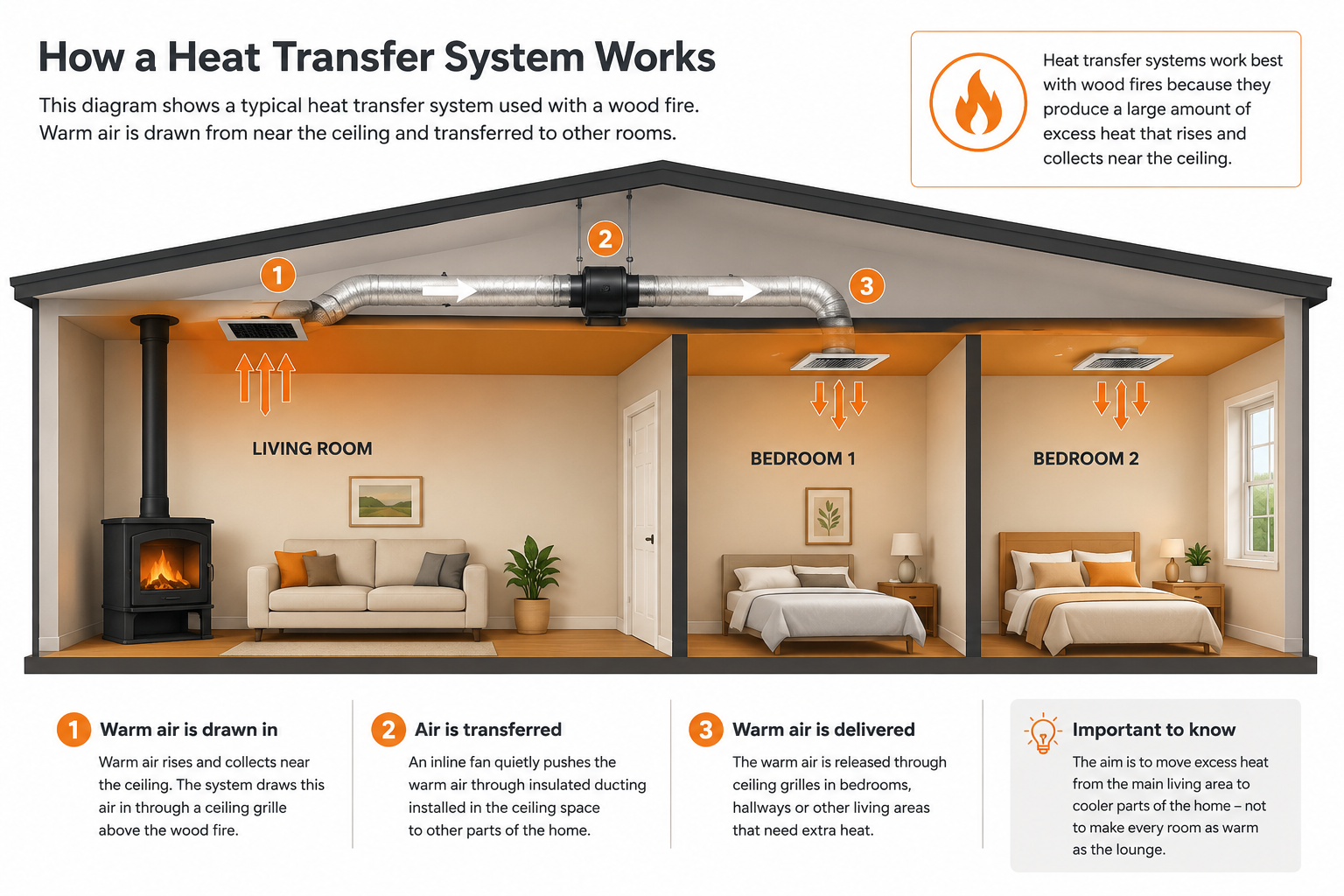
The animation below shows a typical heat transfer system installed in a home with a wood fire. Warm air is drawn from a ceiling grille positioned above the fire, then pushed through insulated ducting by an inline fan to nearby bedrooms or hallways.
Heat transfer systems work best when there is a large amount of excess heat available, which is why they are so effective when paired with a wood fire. The aim isn’t to make bedrooms as warm as the lounge, but to recover heat that would otherwise collect near the ceiling and redistribute it to cooler parts of the home.
Frequently Asked Questions
Can a heat transfer system work with a heat pump?
It can move air from the heat pump room to another room, but in most homes it does not work well enough to recommend. There is usually not enough excess heat sitting at ceiling level to transfer effectively.
Why do heat transfers work better with fires?
A fire often produces far more heat than the living room needs. That extra heat collects near the ceiling and can be captured and moved to nearby rooms.
Will a heat transfer system heat my bedroom?
It may lift the bedroom temperature by a couple of degrees and make it more comfortable, especially with a fire as the source. It should not be treated like a dedicated heater in the bedroom.
How long can the duct run be?
Shorter is better. Long duct runs, multiple bends and cold roof spaces reduce performance. A nearby room or hallway gives a much better result than a long run to the other end of the house.
Should I install another heat pump instead?
If the goal is reliable heating in another room, another small heat pump or a ducted heat pump system is often a better investment than a heat transfer system from an existing high wall unit.
So, Should You Use a Heat Transfer System with a Heat Pump?
In most cases, no. A heat transfer system is usually not the right match for a standard high wall heat pump because the heat pump is designed to condition the room it is installed in, not create a large amount of excess heat to move elsewhere.
Heat transfer systems are best matched with fires and other strong central heat sources where heat builds up near the ceiling and would otherwise be wasted.
If you want to heat multiple rooms properly, consider a second heat pump, a dedicated heat source in the room, or a ducted heat pump system designed for whole-home comfort.
Related Guides
To keep this guide focused, these related topics are best covered in their own articles.
- Will One High Wall Heat Pump Heat My Whole House?
- Why Is My RCD Tripping?
- Why Are My Lights Flickering?
- Should I Upgrade My Lights to LED?
Need better heating in more than one room?
We can help you compare realistic options, including another heat pump, hallway placement, or a ducted heat pump system.